



Before you place your next bulk order of wholesale pearl strands, it helps to arm yourself with a quality-assurance checklist you can hand to any supplier up front. Want one? Read on and I'll show you exactly what belongs on it.
The same pattern has played out in front of me over and over. A designer sees $18 per strand from one vendor and $23 from another, so she orders 100 of the cheaper wholesale pearl strands. When the box lands and she starts sorting, only about 12 to 15 pearls per strand are worth keeping. The rest are chipped, flat-spotted, or don't match in luster. What looked like a bargain became a 40% write-off.
Sticker price per strand is the wrong number to chase. What actually matters is usable yield. A $23 strand where 85% of the pearls are good will out-earn a $18 strand at 50% every single time. Most vendors stay quiet about this, and the honest reason is that they've never measured their own waste rates.
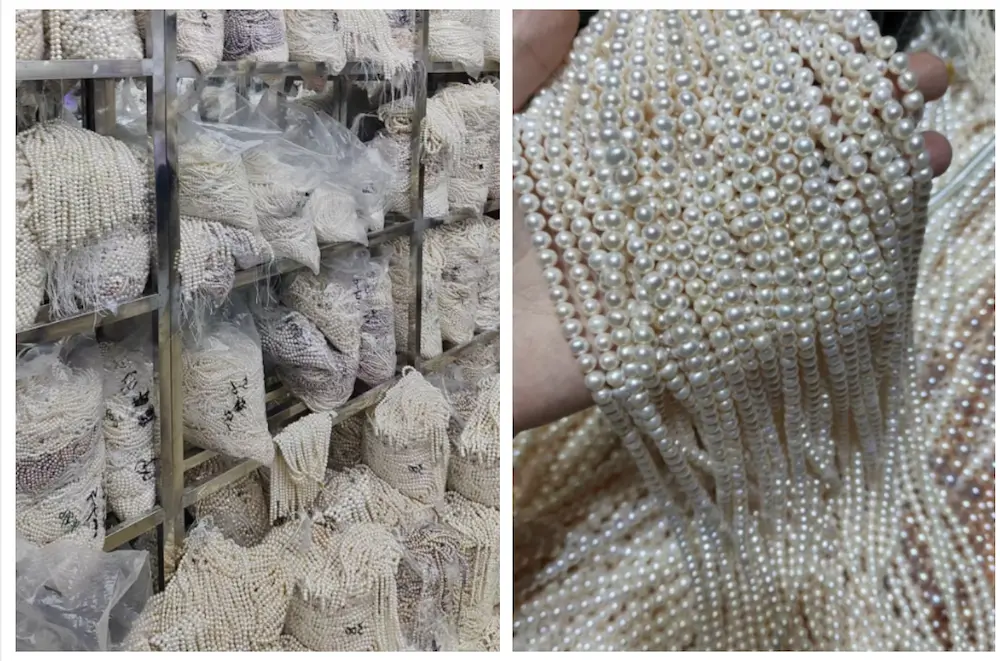
We have. Every production batch at Zhihang Jewelry gets measured for exactly this. Our factory sits in the part of China that supplies the bulk of the world's freshwater pearls, and we've been processing pearls for years. This guide opens up how wholesale pearl strands are really produced, graded, and priced, plus the checks worth running before any money leaves your account.
Secret #1: The “End-to-End” Consistency Test
The trick works like this. A trader gathers mixed-grade pearls from several farms, then cherry-picks the roundest, cleanest ones and strings them at both ends of the strand, right where a buyer's eye lands first. Everything weaker gets buried in the middle. You won't spot it until you cut the strand apart to build earrings or a bracelet.
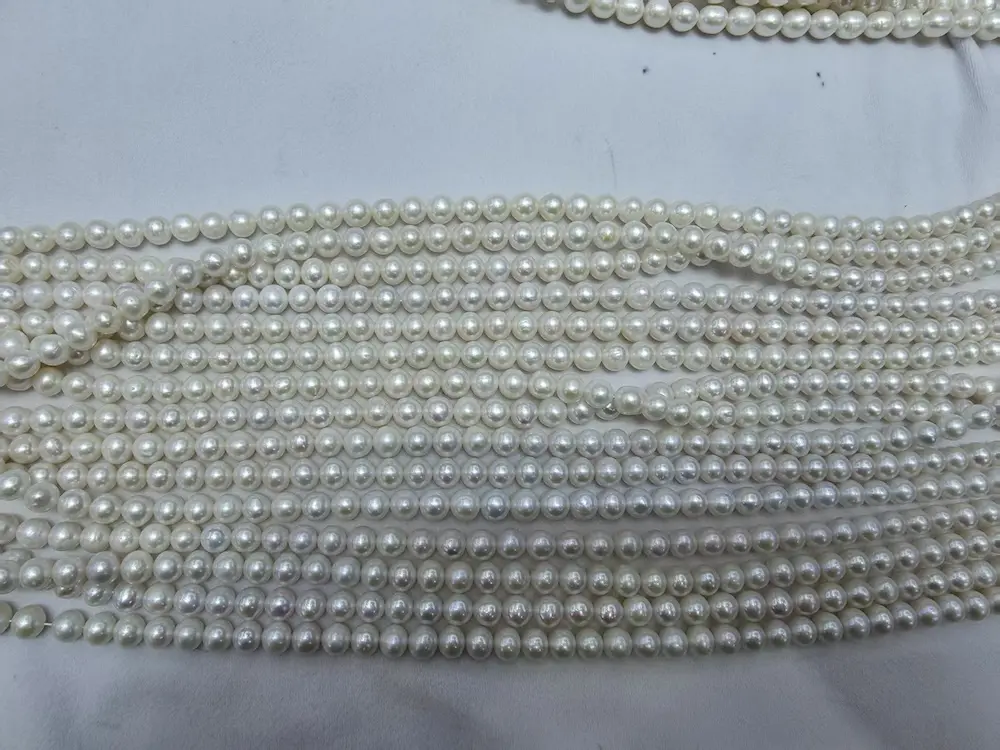
It's a routine move in China's pearl markets. Not every trader plays this game, but plenty do, so it's on you to verify.
How to test it: when your sample turns up, don't stop at the clasp. Snip the thread (or request an unstrung sample) and inspect the pearls sitting at positions 8 to 12 and 28 to 32 on a 40cm strand. Hold them against the two ends. Any drop in luster or shift in surface quality means the grading isn't consistent.
Zhihang Jewelry grades a strand as a single unit. When we label it AAA, every pearl clears the AAA bar, not only the ones on display. During QC we shoot photos of random sections and can share them with you before anything ships.
Table 1: Consistency Check Points for a 16-inch Strand
| Position | What to Check | Red Flag |
|---|---|---|
| Pearls 1-3 (near clasp) | Surface quality, luster | Too perfect compared to middle |
| Pearls 8-12 (early middle) | Blemishes, shape consistency | Noticeable quality drop |
| Pearls 18-22 (center) | Color matching, nacre thickness | Thin nacre, color variation |
| Pearls 28-32 (late middle) | Luster uniformity | Chalky or dull patches |
| Pearls 38-40 (end) | Overall grade match | Matches start but not middle |
Secret #2: Luster Longevity (Why Cheap Pearls Turn Chalky)
Fast-forward half a year. Will these pearls still look the part? A lot of them won't, and one culprit is behind it: bleach.
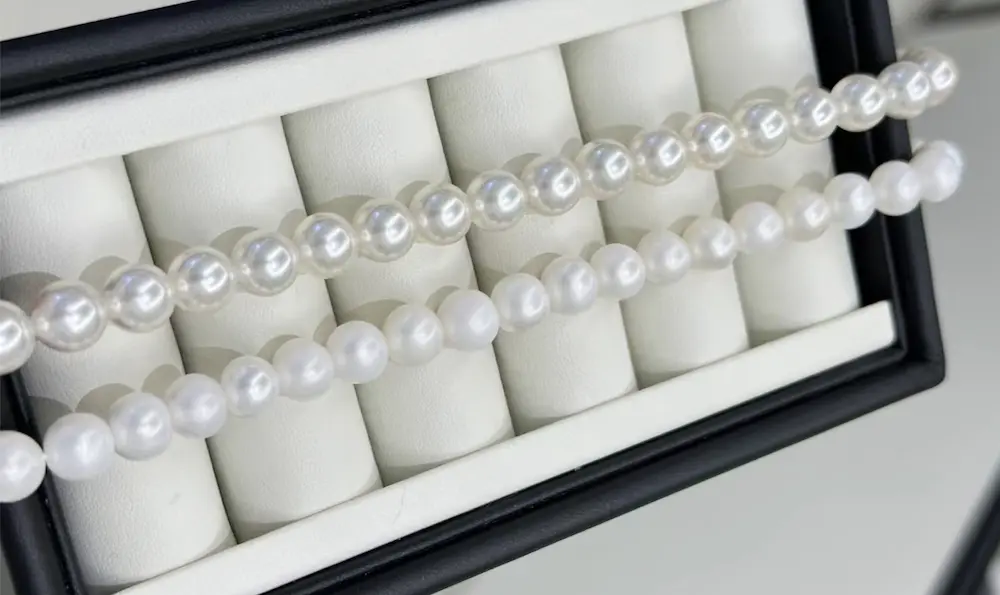
Cheaper freshwater pearls, the ones carrying yellow undertones or patchy color, are often chemically bleached to read bright and white. It does the job for a stretch. But heavy bleaching eats away at the conchiolin, the protein network that binds the aragonite crystals, leaving the nacre porous. Six to twelve months later the shine is gone and the pearls dry out to a chalky white, like paint past its prime.
Customers spot it. Returns pile up. Your Etsy rating slides.
Our approach uses hydrogen peroxide at low strength (3-5%), and only on pearls needing a light color correction. It's slower, 3 to 4 days rather than 8 hours, but it leaves the nacre structure intact. Pearls handled this way keep their luster for years instead of months.
How to test it: ask a supplier to walk you through the bleaching protocol behind their wholesale pearl strands. “Standard industry process” is a dodge, not an answer. “We never bleach” is almost certainly false, since nearly all commercial pearls see some treatment. The reply you're looking for names a specific chemical, a concentration, and a duration.
No straight answer means you should treat the pearls as over-bleached.
Secret #3: The Profit Math (Why Buy Strands vs. Finished Jewelry)
This is the point where bulk pearl strands stop being a purchase and start becoming margin.
Picture yourself as a US bridal designer. One path: buy a finished pearl necklace wholesale for $65. The other: buy quality wholesale pearl strands at 16 inches for $22, string them yourself (or hire it out for $8), add a $3 clasp, and sell the finished piece at $120.
So which route puts more money in your pocket?
Cost Breakdown:
| Option | Material Cost | Labor | Clasp | Total Cost | Sell Price | Margin |
|---|---|---|---|---|---|---|
| Pre-made necklace | $65 | $0 | included | $65 | $120 | $55 (46%) |
| DIY from strand | $22 | $8 | $3 | $33 | $120 | $87 (73%) |
And it only improves from here. That same $22 strand can be turned into:
- 1 necklace (16 inches)
- OR 2 bracelets (7-8 inches each)
- OR 20 pairs of stud earrings (40 pearls total)
- OR 4 pairs of drop earrings
Stud earrings on Etsy tend to sell for $18-28 a pair. A single $22 strand yields 20 pairs, so you're looking at $360-560 in potential sales built on $22 of raw material.
Pound for pound, wholesale pearl strands are the highest-ROI form of inventory in this trade. A finished piece commits you to one design; a strand keeps you free to chase whatever's actually moving.
Secret #4: Drill Hole Quality (The Detail Nobody Mentions)
I've watched gorgeous AAA strands get wrecked by nothing more than sloppy drilling.
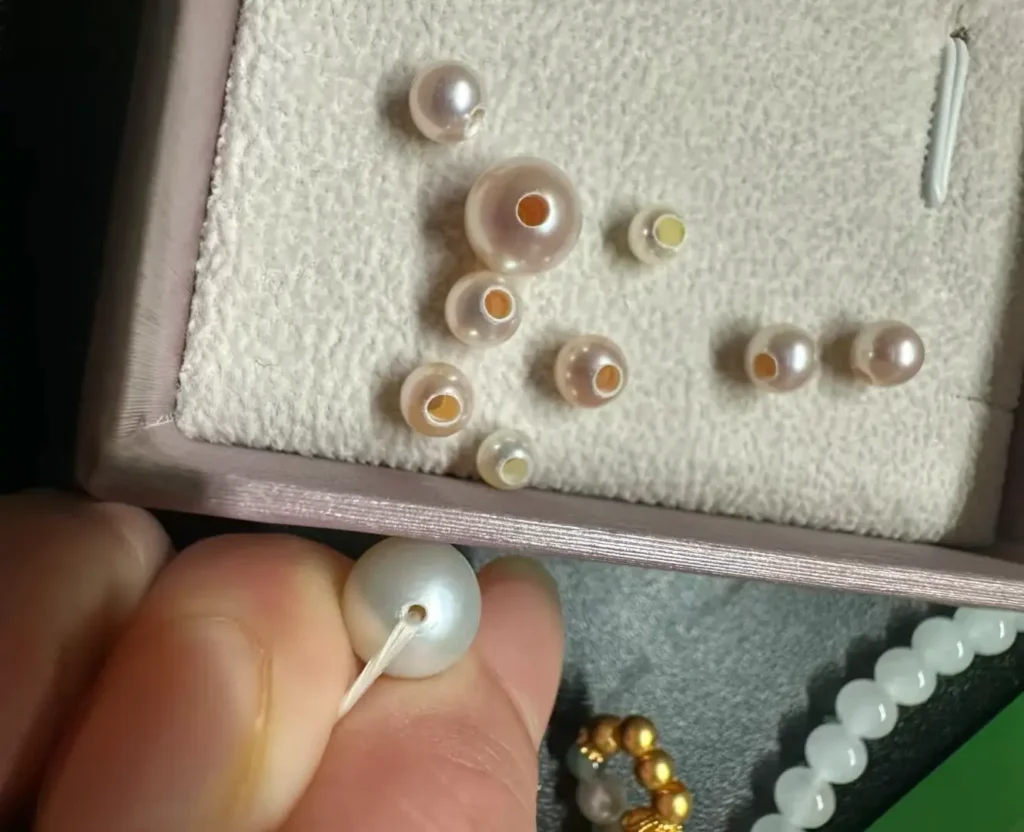
Drill a pearl too quickly, or with a dull bit, and the exit point “blows out”, leaving a ragged, chipped rim around the hole. It's a frequent flaw in cheaper wholesale pearl strands and it can sabotage your whole run. On stud earrings the post snags that rough rim; on a strung necklace the thread wears through and frays sooner.
Seasoned jewelry makers inspect drill holes before they commit. Hobbyists usually don't even know to look.
What to check:
- Center alignment: the channel should pass straight through the pearl's central axis rather than veering to one side. Drill it off-center and the pearl hangs at a crooked angle.
- Smooth edges: drag a fingernail around both openings. Neither one should catch on a sharp lip or a chip.
- Consistent diameter: for most stringing work, holes want to be 0.7-0.9mm. Go smaller and thicker thread won't pass; go larger and the pearl drifts loose on the wire.
Zhihang Jewelry relies on diamond-tipped bits and a two-pass method, a pilot hole followed by a finishing pass, to leave the edges clean. We run at 8,000 RPM under water cooling so heat can't crack the nacre. That adds roughly 15% in equipment and time versus rushing the job, but it pulls the reject rate down from 8% to under 2%.
When a supplier can't name their bit type or their RPM, it's a fair bet their quality control is loose.
Secret #5: Grading Standards Are Not Standardized
Here's the part nobody enjoys admitting: no worldwide standard governs freshwater pearl grading.
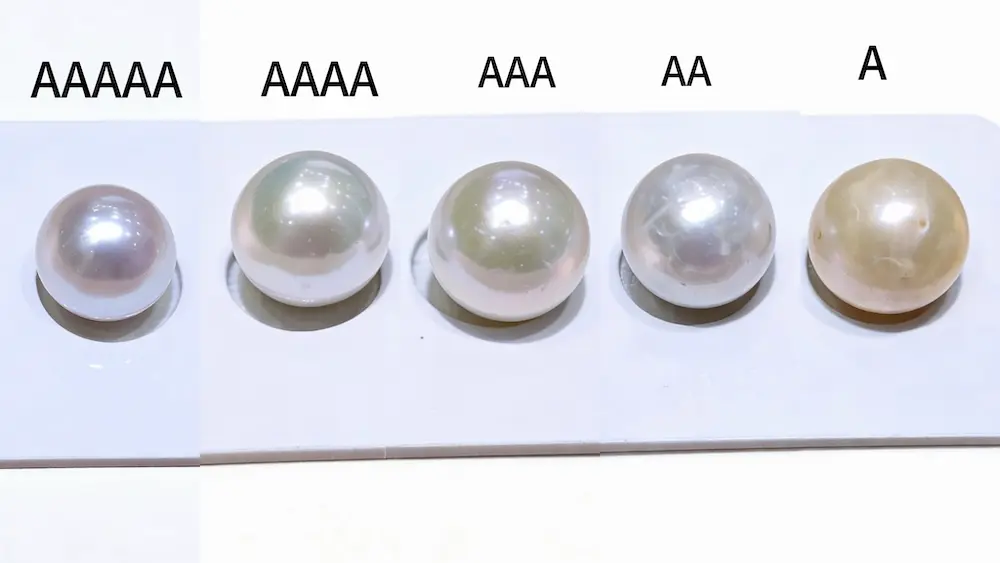
What one supplier calls AAA, the next calls AA. Some factories run a 4-tier scale (A, AA, AAA, AAAA); others stretch it to 5 (A, AA, AAA, AAAA, AAAAA). A few tack on plus signs (AA+), and some swap letters for number codes (A1, A2). It's a free-for-all.
The Gemological Institute of America (GIA) does publish grading guidelines for pearls, but they describe rather than dictate. Most wholesalers ignore them, because following them would wipe out half their stock.
So where does that leave you?
Quit trusting the letters and ask for hard specifics on round pearls:
- Surface: how clean is the skin? At AAAA, roughly 95% of the surface should be free of blemishes.
- Luster: is your reflection sharp in it? AAA calls for a crisp, mirror-like return of light, not a hazy glow.
- Shape: are they genuinely round? We require that a pearl stray no more than 5% from a true circle.
- Color Consistency: a strand shouldn't read like a patchwork quilt. Every pearl should fall within the same tone.
- Size: tolerances count. On a strand listed as 9-10mm, the real spread shouldn't run past 0.3mm.
We document our grading standards in photos and attach them to every quote, so buyers see precisely what they're paying for.
Table 2: Zhihang Jewelry Grading Reference (Freshwater)
| Grade | Surface Clean | Luster | Roundness | Typical Use |
|---|---|---|---|---|
| AAAAA | 99-100% | Mirror (sharpest) | 95%+ round | Ultra-luxury, collectors |
| AAAA | 95-98% | Mirror | 92%+ round | High-end bridal, luxury boutiques |
| AAA | 90-95% | Sharp reflection | 90%+ round | Bridal, fine jewelry |
| AA | 85-90% | Good reflection | 75%+ round | Fashion jewelry, daily wear |
| A | 70-84% | Moderate shine | 60%+ round | Costume jewelry, craft projects |
Top Picks: Which Wholesale Pearl Strands Should You Stock in 2026?
The market is pulling apart at both ends. At one extreme sit brides happy to spend $300-800 on a classic white pearl necklace built from top-tier wholesale pearl strands. At the other are Gen Z shoppers on TikTok chasing baroque pearls, keshi pearls, and anything that reads nothing like their grandmother's jewelry box.
Here's what's leaving our factory the fastest right now:
For High-End Retail and Bridal
Edison Pearl Strands (9-14mm)
If you need pearls that carry a premium price tag, this is the category. Edison pearls are bead-nucleated freshwater pearls rather than tissue-nucleated like the freshwater majority, and that difference is why they reach larger diameters and rounder shapes with a bold, metallic shine that stands out in product photos.
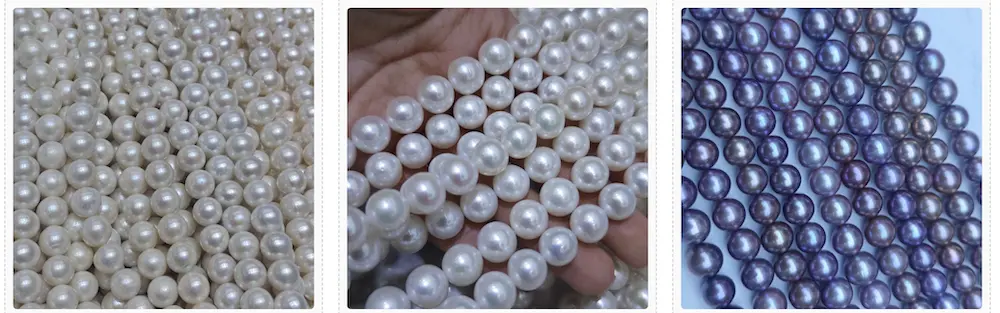
Our 11-12mm Edison strands run $180-240 each, with the exact figure tied to color. Once a jeweler finishes them into necklaces, the retail tags typically land somewhere between $600 and $1,200.
The colors moving best in 2026: natural purple, peacock green, and whites that carry a soft pink overtone.
→ See our Edison Pearl collection here
For Bridal Designers
White Freshwater Round/Near Round Strands (7-8mm, 8-9mm AAA grade)
This remains the go-to size for the timeless bridal necklace. Brides ask for it, so do their mothers, and demand for it simply never fades.
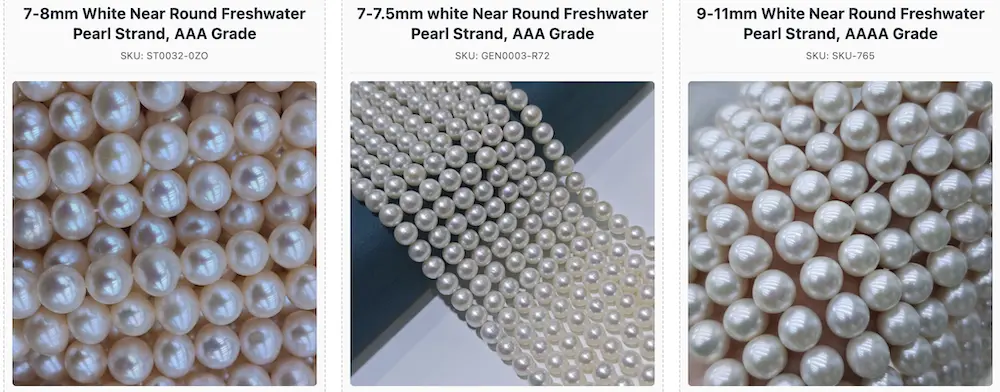
We list these from $28-80 per strand across AA/AAA/AAAA grade. String up a 16-inch piece, finish it with a 14k gold clasp or an S925 Silver clasp, and it comfortably retails in the $150-400 range.
You won't see enormous margins here, but the turnover is dependable. With bridal season stretching from February through October, these strands keep selling at a steady clip.
→ Browse white freshwater pearls
For Etsy Sellers and Trendy Boutiques
Baroque and Keshi Strands
Over the past couple of years, this is the segment that has absorbed most of the demand. Anything irregular, baroques, keshis, potato and rice shapes, now outpaces round pearls, because buyers read those shapes as one-of-a-kind and artisanal.
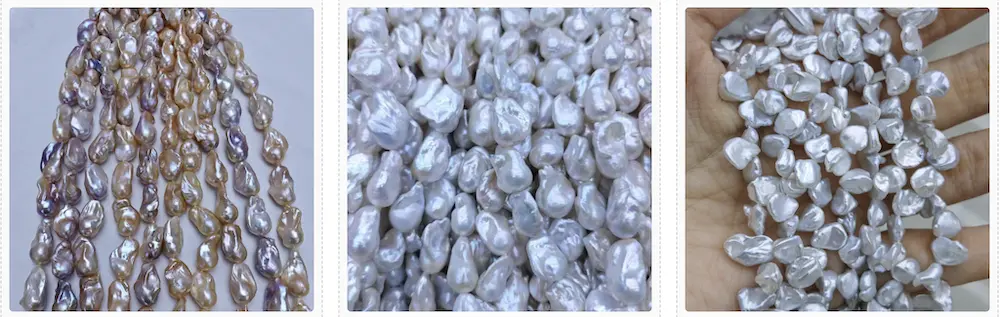
Depending on size and color, our baroque strands sit at $12-22. Sellers turn them into solitaire pendants, mismatched earring pairs, and stacked necklaces. The per-piece markup is thinner, yet shoppers assign more value precisely because no two pearls are alike.
Top styles to reach for: large baroque (12-15mm), undyed natural-color keshi, and stick pearls suited to contemporary designs.
→ Check out baroque and keshi options
How to Actually Source Wholesale Pearl Strands (Without Getting Burned)
The secrets are behind you. Here is how the sourcing itself should go.
Step 1: Request graded samples
Never commit off a photo. Spend the $30-60 (shipping included) to get samples in hand, so you can inspect the drill holes yourself and judge the luster under a few different light sources.
Step 2: Cut one strand open
That's right, sacrifice a $20 sample. Lay every pearl out in a row and shoot a photo. That single image reveals whether quality holds from one end to the other. See it fall off toward the center? Skip the bulk order.
Step 3: Start with a small bulk order
Open with 20 or 50 strands rather than 500. Sending one flawless sample is trivial for any supplier; holding that standard across a full production run is another matter entirely. Prove the consistency on a modest batch before you tie up capital in serious inventory.
Step 4: Negotiate payment terms
Plan on paying in full before your first order ships. After you've built some trust, usually two or three clean deliveries in, you can move to a 50% deposit with the remainder due at shipment. A Letter of Credit (L/C) is another way to protect the transaction.
FAQs about Wholesale Pearl Strands
How many pearls are in a 16-inch wholesale strand?
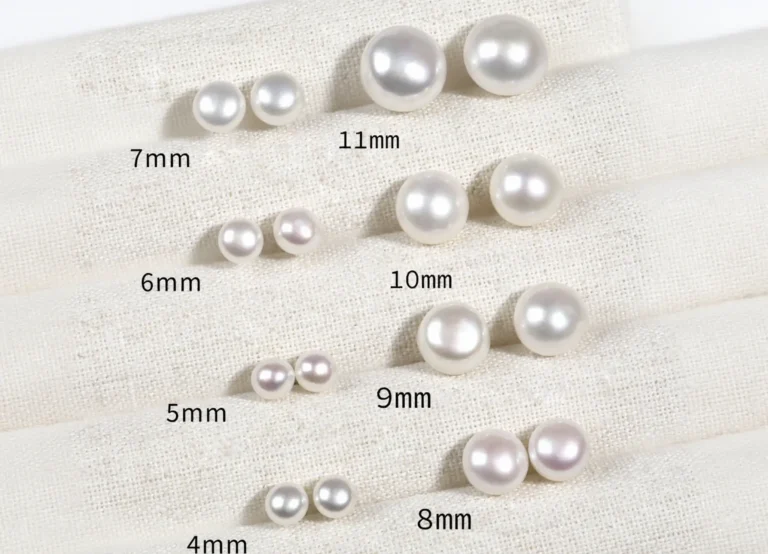
The count comes down to diameter. Taking a standard 16-inch temporary strand as the baseline, the rough numbers are: 6-7mm: ~65-70 pearls; 8-9mm: ~50-55 pearls; 10-11mm: ~40-45 pearls; 12-13mm: ~32-36 pearls. Treat these as approximate. A pearl labeled 8mm is seldom precisely 8.0mm, sizes drift across a lot, and the way pearls are spaced on the temporary thread can shift the tally by one, two, or more.
What's the difference between “loose pearls” and “pearl strands”?
Loose pearls arrive unstrung, sold one at a time or in bulk bags, priced either by weight in grams or by the piece. They hand you complete freedom but leave the sorting and matching to you. Strands, by contrast, come pre-sorted and temporarily strung, generally on nylon. Because the pearls in a strand are already matched for size and color, you skip hours of tedious work, and the temporary stringing lets you picture the finished piece straight away. Unless you're crafting bespoke one-off designs that call for hand-picking every pearl, strands are the more practical choice for most makers.
Do you ship wholesale pearl strands to the USA/UK?
Yes, our shipping reaches worldwide. When speed matters we lean on DHL, UPS or FedEx (4-7 days), which comes to roughly $25-45 for anything under 2kg. Not in a hurry? China Post costs less at $12-18, but plan on 2-3 weeks.
Can I request custom sizes or colors?
Yes, although the minimum order shifts with the request. Keep to standard stock, say 7-8mm white or 9-10mm natural, and the floor drops to just 10 strands.
What's your return/exchange policy?
Should our grading fall short or the pearls fail to match the photos you approved, we'll swap them out or issue a refund. Simply email us within seven days of delivery and attach pictures of the issue. What we can't take back are returns driven by a change of heart or minor color shifts. Pearls are organic, and they genuinely read differently under warehouse lighting than in daylight. That's exactly why we push for samples ahead of any large commitment, it heads off unpleasant surprises.
How should I store wholesale pearl strands?
Store them somewhere cool and dry, out of direct sun. Skip airtight plastic bags, since pearls rely on a little ambient moisture to keep the nacre from drying out and cracking. Fold the strands into soft cloth and tuck them into wood, boxes or drawers both work well. Steer clear of plastic and sealed containers, because these organic gems need to breathe. Keep chemicals well away, especially perfume and hairspray, which corrode nacre. Holding stock beyond six months? Slip a damp cloth into the box to hold humidity, because pearls left to dry out will crack.
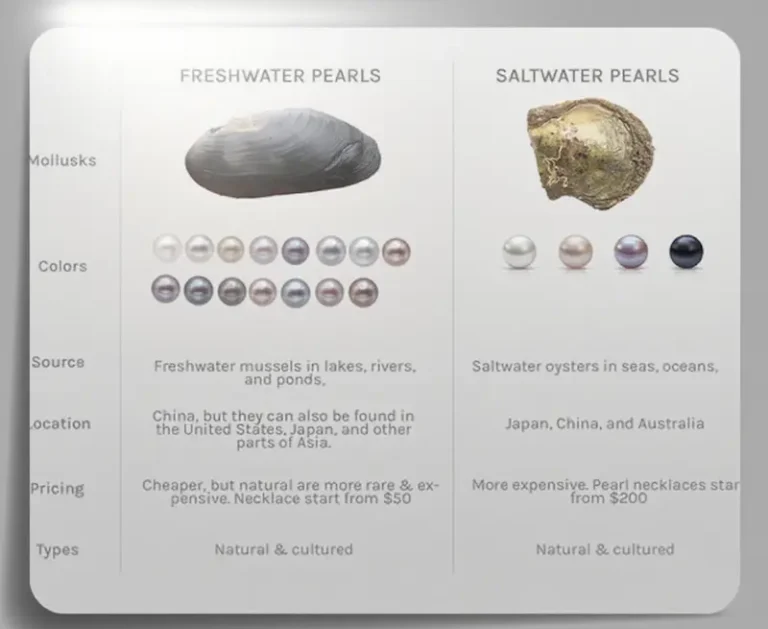
What's the difference between freshwater and saltwater wholesale strands?
Freshwater strands tend toward baroque or near-round shapes, carry thick nacre, and turn up in a broad spectrum of natural colors. Price range: $10-300 per strand. Saltwater pearls, meaning Akoya, Tahitian, and South Sea, grow inside ocean oysters. They lean rounder, wear thinner nacre, and cost more. Price range: $100-5,000+ per strand. For anyone buying wholesale, freshwater delivers stronger margins thanks to lower material cost, yet top-grade freshwater still lets you reach a genuinely high-end look.
Ready to Source Smarter?
Quit paying for waste. Quit rolling the dice on uneven quality.
What separates profitable pearl jewelry from inventory that bleeds money is simply knowing which questions to raise and which details to verify. Price alone is a poor guide. Letter grades mean little without photos to back them. And no one should commit to 500 strands before putting 50 to the test.
If stocking wholesale pearl strands is a real plan for you, begin with samples. We'll send graded strands alongside QC photos, so you know precisely what's coming before any bulk commitment.
Got questions on grading, MOQs, or shipping? Reach us by email at info@pearl-supplier.com or drop into the chat. We're on GMT+8 and usually reply within 3 hours on business days.