




What This Guide Covers
Because pearls are measured in millimeters, even a single millimeter shifts how a finished piece reads on the body. In this pearl size guide we lay out the full spread from 3mm up to 20mm, and we flag what each range means for strands, necklaces, earrings, rings, and pendants.
The short version: pearls in the 5-7mm band tend to stay understated and comfortable, the 7-9mm band is the workhorse that suits almost anything, and anything 10mm and up starts to read as a deliberate statement. Scan the chart first, then narrow down by pearl variety and by the style you have in mind.
Once you have a size chart in front of you and a little context, the picture comes together fast. You start to see how diameter ripples through everything about a pearl, from its presence on the skin to its price and the occasions it suits.
Pearl Size Chart in Millimeters
| Pearl Size | Visual Feel | Common Use |
|---|---|---|
| 3-4mm | Tiny and delicate | Seed pearl designs, fine chains, accent work |
| 5mm | Compact and understated | Petite studs, children's pieces, dainty bracelets |
| 6mm | Easy everyday scale | Modest studs, simple necklaces, layering strands |
| 7mm | The classic small-to-medium range | Daily studs, bracelets, shorter strands |
| 8mm | Well-balanced and easy to notice | Traditional pearl earrings, necklaces, retail lines |
| 9mm | Distinctly bigger | Premium studs, strands, pendants |
| 10mm | A statement that still wears comfortably | Bigger earrings, pendants, bolder necklaces |
| 11-12mm | Commands attention | Statement earrings, rings, designer work |
| 13-14mm | Big and dramatic | Edison pearls, baroque pieces, focal designs |
| 15-16mm | Bold and uncommon | Collector pearls, premium pendants, statement jewelry |
| 17-20mm+ | Exceptionally rare oversized pearls | South Sea, large baroque, custom designs |
Treat this chart as a fast reference point. How a pearl actually reads shifts with its variety, shape, mounting, and the overall style of the piece.
Pearl Size Basics Explained
Gauging a pearl's size is straightforward once the method is clear: you take its diameter in millimeters, exactly as every pearl size chart records it. Jewelers worldwide rely on this single convention. It sets pearls apart from other gems, which are more often judged by weight or by length.
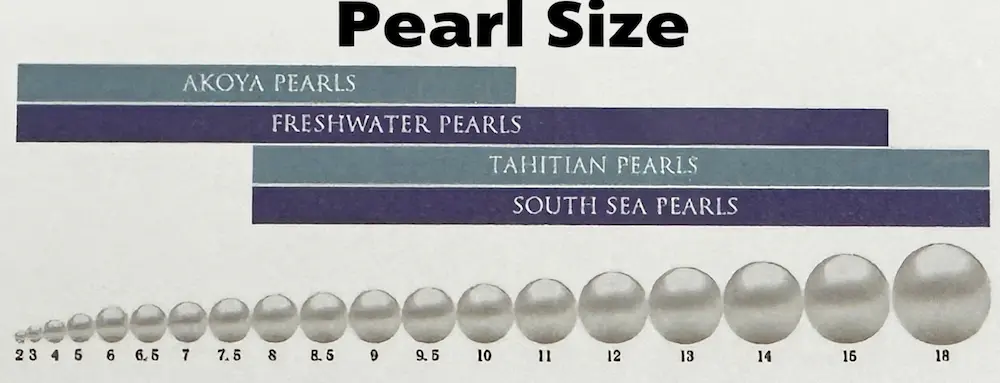
The standard bands break down as follows:
- Small pearls: below 7mm
- Medium pearls: 7-9mm
- Large pearls: above 9mm
Each pearl variety carries its own size range (Freshwater, Akoya, Tahitian, South Sea)
How the trade brackets sizes depends on which pearl you are dealing with:
- Akoya and Freshwater pearls are sorted in half-millimeter or one-millimeter steps. A strand is quoted as a span rather than a single figure, for instance 6.5-7.0mm.
- Tahitian, South Sea, and Edison pearls reach larger diameters, so the trade steps them in full millimeters. Expect to see them written as 10-11mm, 11-12mm, 12-13mm, 13mm+, and so on.
These brackets give jewelers and buyers a shared vocabulary, which is exactly what any solid pearl size guide sets out to provide.
Different types of pearls reach their own natural size ranges. Freshwater pearls generally land between 5mm and 13mm, and Akoya pearls usually sit from 6mm to 9.5mm. The giants are the Tahitian and South Sea, which can push all the way to 20mm and beyond.
Common Pearl Sizes from 3mm to 20mm
To picture these diameters more easily, here are the 12 common size bands paired with everyday objects, matching what you see on this pearl size chart:
- 3-4mm pearls - about the size of an unpopped popcorn kernel (seed pearls)
- 5mm pearls - roughly a pencil eraser across (delicate jewelry)
- 6mm pearls - close to a whole peppercorn (a good starter size)
- 7mm pearls - near a small blueberry (a crowd favorite)
- 8mm pearls - about a chickpea (timeless elegance)
- 9mm pearls - the size of a standard marble (premium territory)
- 10mm pearls - like a large grape (statement pieces)
- 11mm pearls - comparable to a cherry tomato (a bigger statement)
- 12mm pearls - about a large olive (real visual weight)
- 13-14mm pearls - the diameter of a ping pong ball (a collector's pick)
- 15-16mm pearls - roughly a quarter coin (genuinely rare)
- 17-20mm+ pearls - from a large marble up to a small golf ball (museum grade)
Pearl Size Chart by Type
Understanding how the varieties stack up against one another sharpens your buying decisions. Each type's size range is set by the mollusk species behind it and the conditions it grew in, a point every pearl size guide reinforces.
| Pearl Type | Common Sizes | Premium Sizes | Rare Sizes |
|---|---|---|---|
| Freshwater | 3-8mm | 9-11mm | 12-15mm |
| Akoya | 6.5-8.5mm | 9-9.5mm | 10mm+ |
| Tahitian | 8-11mm | 12-14mm | 15-20mm |
| South Sea | 9-13mm | 14-16mm | 17-20mm+ |
| Keshi | 3-12mm | Varies | Varies |
Freshwater Pearl Sizing
Freshwater pearls span an unusually broad size range, which is what makes them so flexible across jewelry styles. As any pearl size chart makes clear, the team at a Pearl Manufacturer will often point first-time buyers toward freshwater pearls, since they deliver strong value and arrive in so many sizes.
The smaller freshwater pearls, from 3 to 6mm, suit light everyday pieces. The mid-range from 7 to 9mm is where classic elegance lives, and anything from 10mm up is built for making a statement. Because freshwater pearls stay affordable, you can experiment across sizes without a heavy outlay.
Akoya Pearl Measurements
Akoya pearls hold their size far more tightly than freshwater ones. As a pearl size guide will confirm, the bulk of them fall in the 6.5mm to 9mm band, and once a pearl clears 9mm it counts as genuinely scarce and highly prized.
A traditional Akoya necklace typically strings pearls in the 7 to 8mm range, delivering the refined, classic look most people picture when they imagine traditional pearl jewelry. Matching every pearl on the strand for size is essential when assembling these necklaces.
Choosing Sizes for Each Jewelry Type
Ultimately the right pearl size comes down to how you intend to wear it and what appeals to you. Certain sizes simply sit and look better in a given piece, and the goal is to strike a balance between visual impact and comfort, which any pearl size guide will underscore.
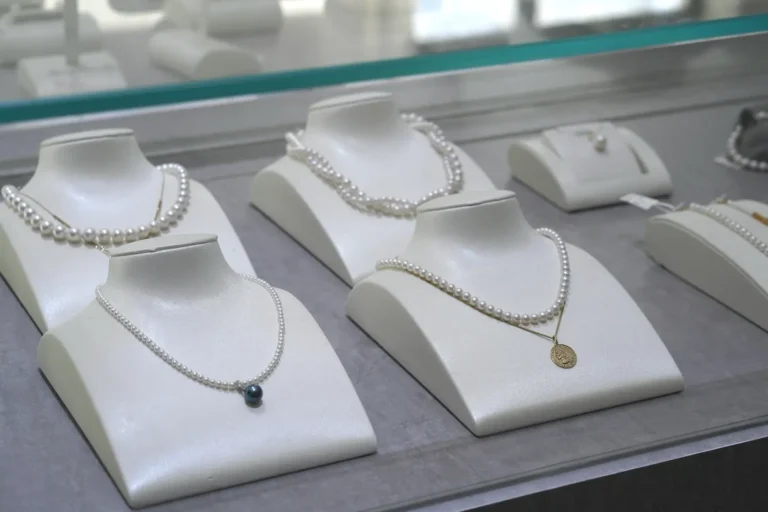
Necklaces and Pearl Strands
For pearl strands, pearl diameter shapes both the look and the feel of the finished necklace. Here is a quick pearl size guide:
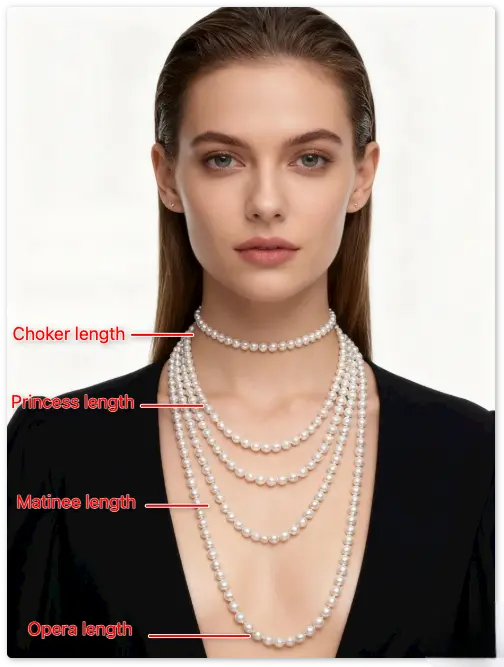
- Choker length (14-16 inches): pearls of 6 to 8mm suit this well. They sit neatly at the throat without overwhelming it, and the smaller size stays comfortable through long wear.
- Princess length (17-19 inches): a natural home for 7 to 9mm pearls. It carries from daytime through to dressier occasions, which is why it remains one of the most popular choices for pearl necklaces.
- Matinee length (20-24 inches): 8-10mm pearls sit best here, giving the longer drop enough presence so the necklace never reads as too slight.
- Opera length (28-34 inches): for this longer, dramatic style, reach for pearls in the 9-12mm band. The extra size keeps them reading clearly all the way down the strand.
When you are settling on strand sizes, check our wholesale pearl strands for the usual freshwater pearl sizes and grades.
Pearl Earrings
Choosing pearl earrings means weighing your face shape, how you wear your hair, and what feels comfortable. As any good pearl size guide notes, the smaller pearls of 5-7mm read as quietly refined and work well for the office or a polished, professional look, while larger 8-12mm pearls push toward a bolder statement.
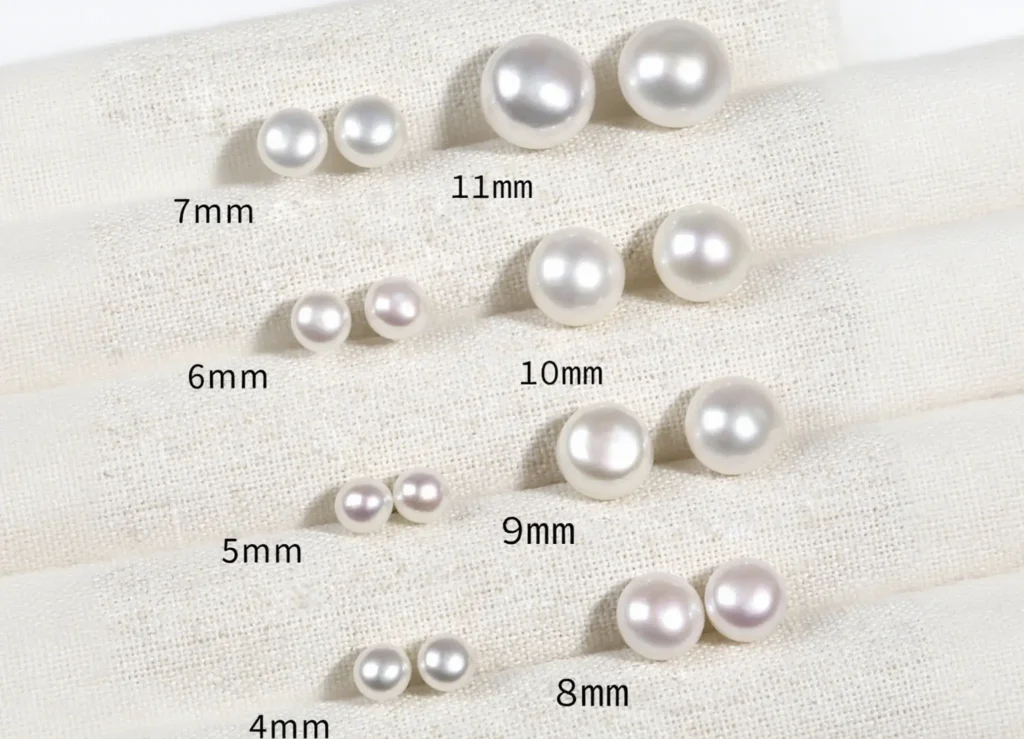
For studs, jewelers hunt for pearls matched almost exactly in size, within about 0.5mm, so the pair looks symmetrical. Drop earrings sometimes step up in size toward the bottom, which helps carry the weight gracefully.
To shop wholesale earring styles sorted by size, browse our pearl earrings collection.
Pearl Rings and Pendants
Pearl rings tend to feature stones in the 8-10mm range, a sweet spot that looks handsome without turning bulky, as any pearl size chart shows. A pearl too large simply becomes awkward to wear day to day.
Pendants give you far more latitude on size. You can go dramatic with a large 12-15mm South Sea pearl, or keep things quiet with a 6-8mm pearl meant for a layered look.
Pearl Bracelets
With bracelets, weight matters as much as appearance.
- 6.0-7.0mm: these give a light, understated effect and pair easily with a watch, chains, or other bracelets.
- 7.5-8.0mm: the default size. Order a bracelet without checking the specs and this is most likely what shows up. They stand well on their own, though they also look great layered with hard-edged metal cuffs that cut against the perfect roundness.
- 11mm+: The moment you reach South Sea diameters, a bracelet stops acting like a bracelet and starts acting like a cuff. The weight is real, it turns on the wrist, and it takes over the whole arm. Stacking is off the table here.
Single strand or full stack, the smart move is to try a few diameters side by side until you land on the look that genuinely feels like yours.
How to Choose the Right Pearl Size
In the end, the ideal diameter is a personal call. It comes down to your taste, the setting you'll wear it in, your budget, and your build. Weigh those factors together and a pearl size guide becomes a quick way to zero in on what suits you.
1. Age and Lifestyle Considerations
Younger wearers tend to gravitate toward the smaller end (5-7mm). Those diameters read as polished without overwhelming, and they slip easily into school, the office, or a casual day out without feeling too formal or mature.
Older women frequently favor the 8 to 12mm range, which reads as assured and refined. That band bridges everyday and professional wardrobes and holds up well at formal occasions.
2. Body Proportions
Your frame has a lot to say about which diameter flatters you. On a petite build, the smaller pearls (6-8mm) usually sit best. Taller wearers can carry the larger sizes (9-15mm) comfortably, without them ever looking oversized.
Neckline plays a part too. A longer neck gives you room to scale up without the pearls dominating, while a shorter neck is better served by smaller, more delicate pearls that stay in step with your proportions.
3. Occasion Appropriateness
Consider the destination as well. As almost any pearl size chart suggests, the smaller, quieter diameters (6-8mm) tend to suit the workplace. They come across as polished rather than attention-seeking.
Weddings, galas, and milestone celebrations are exactly where the bigger, bolder diameters (9-15mm) earn their keep, delivering a memorable statement that matches the weight of the moment.
How to Measure Pearl Size
Measuring a pearl accurately takes proper technique and the proper equipment. Digital calipers are the tool experienced jewelers reach for when they need precise readings, so a set can be matched cleanly and buyers get size information they can trust.
Measuring Pearl Diameter
To gauge a pearl's size, measure across its widest point, and on a drilled pearl take that reading straight across the drill hole. Pearls that stray from round, such as baroque shapes, are harder to pin down, and you'll typically record both a length and a width.
Any solid pearl size guide will echo what specialists advise: only measure pearls that are clean and dry. A film of oil, a bit of grit, or even trace moisture can skew the number, which matters most when you're pairing pearls for a necklace or a set of earrings.
Size Matching for Strands
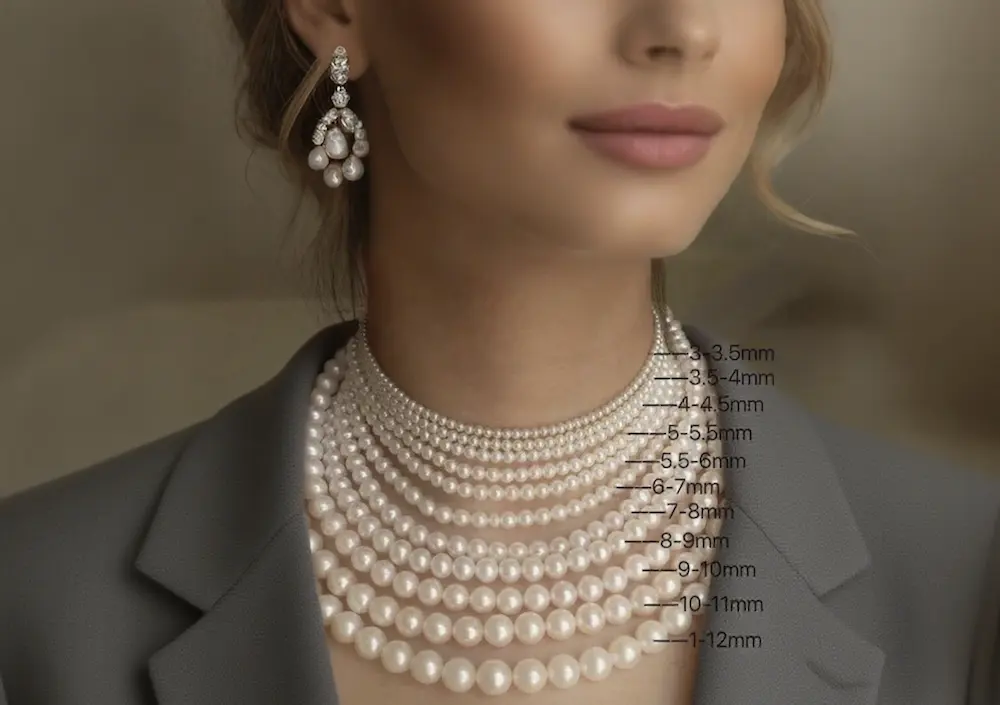
Building a uniform pearl necklace means being meticulous about how the pearls pair up. As a rule, professionals permit no more than a 0.5mm gap between pearls on the same strand, and the finest necklaces tolerate even less than that.
There are also graduated necklaces, where the pearls swell toward the center. These are engineered so the diameters shift in a deliberate progression that looks balanced and drapes gracefully.
Size Impact on Pearl Value
Naturally, diameter has a strong pull on what a pearl is worth. Larger pearls command more across every type. Yet size isn't the whole story, since a pearl's other qualities feed into the final figure too. Price is really the sum of several factors.
Market Preferences
At the moment, the market's comfort zone sits in the middle diameters (7-9mm). They strike a workable balance between a size you can see and a cost most designs can absorb. For the casual admirer and the committed collector alike, they represent good value.
The truly large pearls (15mm and up) lean toward collectors or anyone chasing a bold statement piece. That's a narrower, more specialized corner of the market with pricing all its own. The Gemological Institute of America points out that cost leaps sharply once you pass certain sizes, rather than climbing at a steady pace.
What the numbers say: The Gemological Institute of America (GIA) notes that pearl prices increase significantly — often by 30–50% or more — each time you cross a size threshold above 9mm. The International Pearl Association confirms that exceptional size, regardless of pearl type, consistently holds collector value even through market fluctuations. Currently, the 7–9mm range represents the sweet spot where buyers get the best combination of visual impact and affordability.
Investment Considerations
When pearls enter the conversation as an investment, size carries real weight, though qualities like overall grade matter just as much. Scarce diameters in top-tier pearl types tend to appreciate more reliably than everyday sizes, which is what draws collectors with a long horizon.
The International Pearl Association makes a related point: exceptionally large pearls of any type reliably spark collector interest and tend to preserve their value even as the broader market shifts.
Common Pearl Size Preferences Today
Contemporary jewelry design leans heavily on varied pearl diameters. The old single-size formula is fading in favor of more inventive mixing, which opens room for self-expression while holding on to the timeless elegance pearls are known for.
Mixed-Size Designs
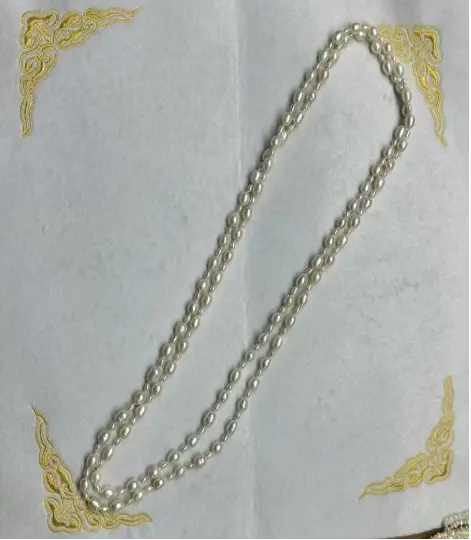
Designers increasingly gather several pearl diameters into a single piece, building intriguing texture and a modern silhouette. Breaking the one-size convention is exactly what unlocks fresh creative directions, as this pearl size guide can help you explore.
Younger buyers hunting for jewelry that feels singular and personal are especially drawn to asymmetric pieces that combine different pearl diameters. Such designs often blend assorted pearl types and sizes to stand apart and reflect an individual sense of style.
Minimalist Approaches
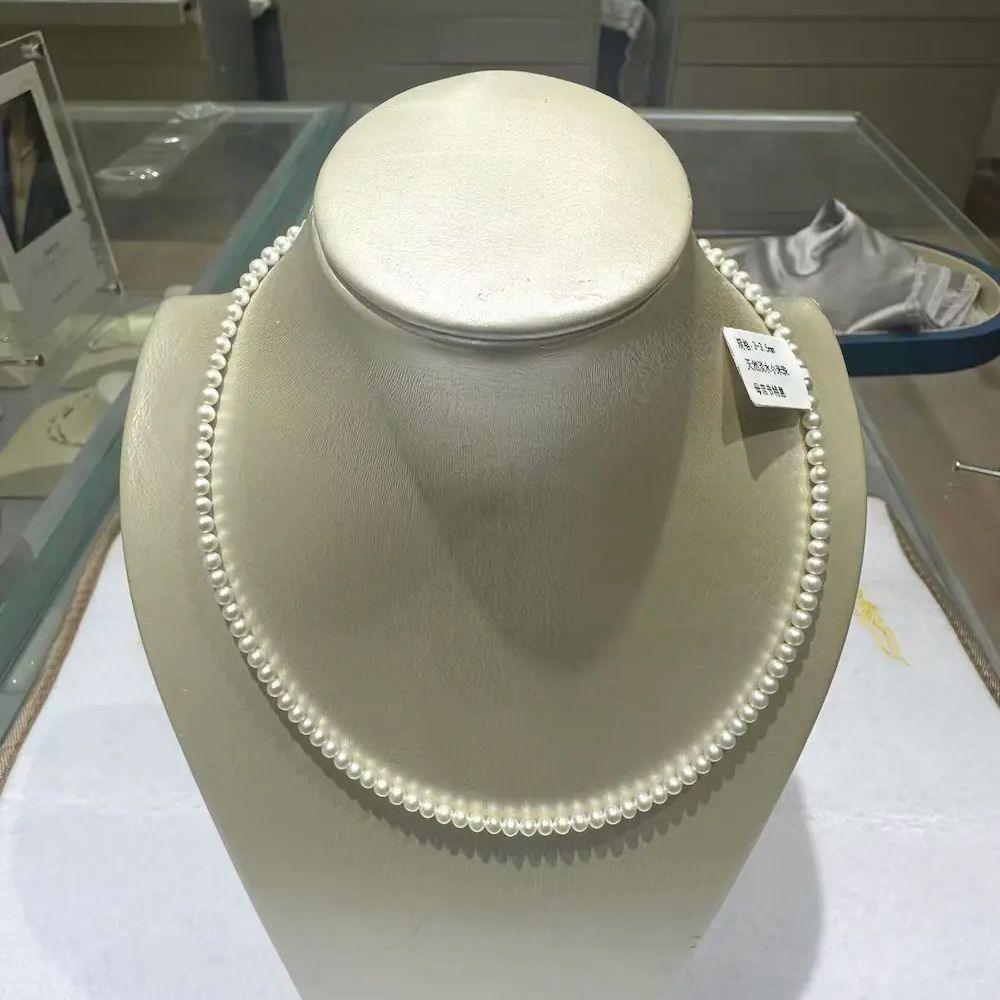
The minimalist aesthetic revolves around the smaller pearls (2-5mm), ideal for layering and daily wear. With these pieces the emphasis shifts to quality — luster, color, and craftsmanship — rather than sheer scale.
Single-pearl pieces, whether necklaces or earrings, let each pearl's beauty carry the design without size stealing the spotlight. They usually feature genuinely fine pearls of moderate diameter, putting their natural character on display.
Care Tips for Different Pearl Sizes
One thing worth flagging: pearls of different diameters call for slightly different care. Larger pearls present more surface that's exposed to damage, while smaller pearls bring their own concerns, from staying firmly seated in the setting to needing a gentle touch during handling.
Storage Requirements
With the larger pearls, give them room so they aren't knocking into one another and picking up scratches. Individual pouches or dividers work well for keeping them apart and preserving their surface over the long run.
Smaller pearls, particularly in multi-pearl pieces, warrant a close eye on clasp security and how firmly each one is set. Periodic professional check-ups confirm they're mounted tight and won't work loose while you wear them.
Cleaning Protocols
Cleaning technique stays largely the same regardless of diameter. That said, larger pearls can call for a little extra attention, since they tend to collect more residue. A soft, damp cloth keeps their shine intact without doing any harm.
For sizable, high-value pearls or an intricate piece that mixes several diameters, professional cleaning is the way to go. Doing it yourself at home can carry some risk, and you may not achieve the result you were after.
FAQs
What is the most popular pearl size?
Across most jewelry, 7-9mm pearls lead in popularity because they're clearly visible without feeling too large. The smaller 5-6mm pearls suit understated earrings and delicate designs, while pearls of 10mm and up shine in statement pieces.
How to determine pearl size?
Take the diameter in millimeters using a ruler or caliper; round pearls are measured at their widest point.
What size of pearl should I buy?
For most day-to-day jewelry, 7-8mm pearls are a sensible pick. Smaller pearls read as more delicate, while 9-10mm pearls make a more noticeable impression.
How big is a size 7mm pearl?
Roughly the size of a peppercorn—a classic stud that registers without shouting.
Are 9mm pearls too big?
Pearls beyond 10mm read as more noticeable and are typically reserved for statement jewelry.
What size pearl should I choose for a necklace?
Choker (14–16 in): 6–8mm | Princess (17–19 in): 7–9mm | Matinee (20–24 in): 8–10mm | Opera (28–34 in): 9–12mm. Bigger pearls counterbalance longer strands, keeping the necklace from looking too slight when viewed from across the room.
What size pearl works best for earrings?
Stud earrings: 5–7mm for a subtle, professional look; 7–9mm for a classic one. Drop earrings can carry pearls that increase slightly toward the base for visual balance. Always keep the left and right earring pearls within 0.5mm of each other.
What size pearl is appropriate for a wedding or formal event?
9mm or larger. That extra size makes a clear statement in photographs and under formal lighting. South Sea pearls in the 12–15mm range are a frequent bridal choice — rare enough to feel special, yet still practical to wear.
What is the largest natural pearl size?
South Sea pearls set the record, reaching 20mm and now and then beyond. Tahitian pearls come next at up to 18mm. In any type, anything past 15mm is regarded as collector grade. The Gemological Institute of America notes that pearl prices climb steeply once you pass the 9–10mm mark — size drives value in a big way.
Conclusion
Treat this pearl size guide as a jumping-off point when you weigh earrings, strands, necklaces, rings, and pendants against one another. If you're sourcing pearls for a jewelry line, the right diameter also hinges on pearl type, grade, setting, order volume, and your target price. For wholesale sizing support, send us the pearl size, shape, grade, and quantity you have in mind, and we can put forward suitable options for samples or bulk runs.
For wholesale sizing help, send us the pearl size, shape, grade, and quantity you're targeting, and we can put forward suitable options for samples or bulk orders.