




Table of Contents
Because freshwater pearl grading has never been locked into a single industry-wide standard, an identical grade label can carry very different meaning from one supplier to the next. In the pages that follow, we walk through the way we assess freshwater pearls — luster, surface, shape, size, color, and matching — and what the A, AA, AAA, AAAA, and AAAAA tiers typically signal to wholesale buyers. A single loosely defined grade can decide whether a line sells through or gathers dust on the shelf, and a solid grasp of Freshwater Pearl Grading is how you sidestep that trap.
Those grading subtleties shape both quality and price. Here we lay out how we grade every shape we produce — round, button, oval, and baroque — spanning the entire size spectrum from 2mm freshwater pearls right through to 15mm+ Edison pearls. You won't find a grade term floating without a number attached to it, and that is exactly what turns a bulk pearl buying guide into something genuinely useful.
What the A to AAAAA freshwater pearl grading system means for wholesalers
Freshwater Pearl Grading gives buyers a sharper reference point. Back when the finest freshwater pearls topped out at roughly "quite nice," the old A–AAA scale did the job. Production has moved on. Premium tissue-nucleated rounds and bead-nucleated Edison pearls now hit quality tiers that a three-step scale simply can't tell apart. Once your highest grade has to stretch over both an ordinary commercial round and a mirror-luster gem, the label stops communicating anything useful.
Where the old scale offered three steps, A–AAAAA offers five. That added precision counts for the most at the upper end, where the gap in price between two neighboring grades can run 40–80%. Confirming whether you're buying AAAA or AAAAA becomes a genuine budgeting call rather than a bit of marketing gloss.
The wider scale earns its keep for another down-to-earth reason: it obliges suppliers to spell out their standards. Slapping "AAA" on a parcel is easy. Articulating what sets your AAAA apart from your AAAAA demands real yardsticks — surface percentage, luster class, shape tolerance. A supplier who can't give you those specifics is waving a warning flag before the order is even placed.
Freshwater Pearl Grade Chart
Grades for freshwater pearls aren't uniform from one supplier to the next. The table below reflects the way we typically walk wholesale buyers through the A to AAAAA tiers, weighing luster, surface, shape, and intended commercial use side by side.
| Grade | Luster | Surface Quality | Shape & Matching | Best Use |
|---|---|---|---|---|
| AAAAA | Intensely bright, mirror-like luster | Effectively clean to the naked eye; only minute natural marks show up on close examination | Top shape uniformity and the tightest matching available within the chosen pearl type | Premium strands, high-end earrings, pendants, and bespoke jewelry |
| AAAA | Bright luster with clear reflection | Slight natural marks, generally unnoticeable once worn | Solid shape uniformity with dependable color matching | Upper-tier wholesale collections, bridal pieces, better retail lines |
| AAA | Respectable luster that still looks appealing in finished pieces | A few visible natural marks, yet fine for most commercial applications | Middling consistency in shape and color | Everyday pearl jewelry, retail lines, studs, bracelets, and strands |
| AA | Gentler luster with a less crisp reflection | More noticeable surface marks or growth lines | Wider variance across shape, size, and color | Fashion jewelry, budget-minded collections, baroque looks, promotional runs |
| A | Modest luster | Obvious surface marks or uneven texture | Pronounced variation in shape and matching | Low-cost jewelry, craft work, design prototyping, or budget-driven orders |
Always weigh grades against others of the same pearl type. A AAAAA baroque and a AAAAA round are held to separate benchmarks, since what counts as good shape isn't the same for each.
Freshwater Pearl Grading: The pearl shapes you're actually buying
Before we dig into grade-by-grade detail, it pays to pin down the shape categories, because the criteria for grading move with the shape. Judging a baroque on roundness makes no sense. For an oval, symmetry is what counts. Buyers who internalize this sort quicker, purchase more shrewdly, and butt heads with their suppliers far less often.
Freshwater Pearl Grading weighs both looks and technical benchmarks. This is how we sort the shapes we carry:
| Shape Category | Definition | Typical Size Range | Common Use Cases |
|---|---|---|---|
| Round | Diameter variance <2% | 5–15mm (Edison up to 16mm) | Classic strands and fine jewelry |
| Near-round / Off-round | Reads round at 6–12 inches | 5–13mm | Everyday jewelry and affordable strands |
| Button | One or both sides flattened, with a circular face | 6–12mm | Earrings, pendants, and face-up settings |
| Oval | Elongated, symmetrical form | 6–12mm | Drop earrings and contemporary designs |
| Baroque | Irregular, freeform | 8–20mm+ | Statement jewelry and artistic pieces |
| Rice / Potato | Elongated oval with slight irregularity | 2–8mm | Layering necklaces and small-format strands |
| AK Pearl (small) | Nucleated, small format, with Akoya-like luster | 2–6mm | Delicate, minimalist jewelry |
| Edison | Bead-nucleated, large-format, round to near-round | 8–16mm | Luxury pieces and South Sea alternatives |
The elements that feed into Freshwater Pearl Grading are what ultimately set value. The 2–6mm AK pearl group is worth calling out on its own. These are nucleated freshwater pearls built around a small bead, and that core lends them the crisp, clean luster people associate with Akoya pearls — but at a fraction of the price. On a good AK pearl the nacre measures 2mm or more, which is precisely why the luster stays strong even at tiny diameters. Anyone developing minimalist or delicate lines will find a quality tier here that loose rice pearls of the same size just can't reach.
How our factory's Freshwater pearl grading standards break down
Grades operate inside each shape category, never across them. A AAAAA button pearl is the finest button we make; it isn't measured against a AAAAA round. Hold onto that distinction whenever you're ordering across different shapes.
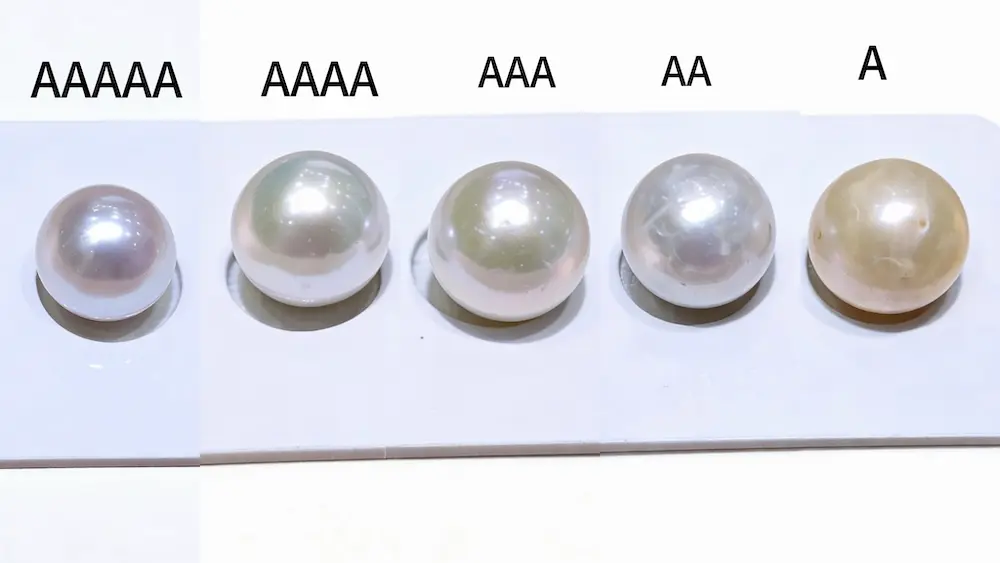
AAAAA grade (gem quality): the rarefied top 1%
For rounds and near-rounds:
| Factor | Standard |
|---|---|
| Surface cleanliness | >99% flawless under 10x magnification |
| Luster | Mirror-like, throwing a sharp facial reflection from arm's length |
| Shape tolerance | Diameter variance <1% |
| Nacre thickness (Edison) | ≥1.2mm |
| Availability | ~1–3% of total harvest |
For button, oval, and baroque:
| Shape | AAAAA Standard |
|---|---|
| Button | Face perfectly circular; flat base ≥90% even; no blemishes on the face surface |
| Oval | Symmetry ratio held within 5%; profile smooth, free of flat spots or ridges |
| Baroque | Mirror-grade luster over ≥90% of the surface; growth lines only, with no pitting or chalky patches |
AAAAA rounds and AAAAA baroque pearls are wholly different products serving wholly different buyers. A gem-grade baroque at this level generally falls between 12–18mm, carrying a luster that commands attention across any display case. These go to designers hunting for a single showpiece to anchor a collection — not to volume buyers stocking a strand order.
Let Freshwater Pearl Grading guide your decisions with confidence. It brings clarity to what you can reasonably expect from one supplier versus another.
Grasping the measures behind Freshwater Pearl Grading is fundamental for any buyer. Sourcing factory-direct freshwater pearls graded at AAAAA means budgeting for a 3–5x premium over AAA goods. That's simply supply meeting demand — we comb through millions of pearls to pull the few thousand that clear this bar.
AAAA grade: premium quality
Rounds:
A firm handle on Freshwater Pearl Grading is how you lock in the right quality for your collection.
| Factor | Standard |
|---|---|
| Surface cleanliness | >95% clean (minor growth marks invisible at 12 inches) |
| Luster | Very high — reflections stay sharp and defined |
| Shape tolerance | Reads round to the eye at 6 inches |
| Nacre depth (Edison) | ≥0.8mm |
Button, oval, baroque:
Getting a firm grip on how Freshwater Pearl Grading works will sharpen your judgment considerably.
| Shape | AAAA Standard |
|---|---|
| Button | Face reads 95%+ clean; a little surface variation near the base is fine |
| Oval | Symmetry holds within 8%; small profile shifts along the sides are acceptable |
| Baroque | Very high luster across ≥80% of the surface; faint concentric rings are permitted |
AAAA is the tier our steady premium-segment accounts reorder most often. The wholesale pearls we ship at this level photograph cleanly, wear well in finished designs, and stand behind a return policy without trouble. For independent designers and upmarket retail programs, AAAA delivers the quality narrative while staying under gem-grade pricing.
Anyone aiming to compete in the jewelry trade will find Freshwater Pearl Grading indispensable.
AAA grade: the commercial sweet spot
Rounds:
| Factor | Standard |
|---|---|
| Surface cleanliness | >90% clean |
| Luster | Good — reflections read clearly, edges slightly soft |
| Shape | Reads round to the eye at 1–3 feet |
Button, oval, baroque:
Study Freshwater Pearl Grading closely and the practical insights follow.
| Shape | AAA Standard |
|---|---|
| Button | Face 90%+ clean; marks show up at ordinary wearing distance |
| Oval | Symmetry is evident; slight profile variation shows only under close inspection |
| Baroque | Good luster throughout; a few concentric rings or light growth marks are allowed |
AAA is the engine of the retail floor. Department-store pearl strands, mid-tier boutique jewelry, and everyday earrings all lean on this grade. It is a genuinely handsome pearl rather than a fallback, priced to leave room for standard retail markup.
The finer points of Freshwater Pearl Grading can meaningfully shape what you choose to buy.
Within the 2–6mm AK pearl category, most buyers treat AAA as the benchmark for fine chain necklaces and petite earring sets. At that size a AAA AK pearl actually out-shines a AAAA freshwater rice pearl — they sit in separate product classes with separate luster baselines.
AA and A grade: value for mass market
AA and A goods carry heavier growth marks, gentler luster, and wider shape variation. In the baroque and oval categories, though, AA is surprisingly usable — because baroque pearls are judged on luster and surface rather than roundness, a well-lit AA baroque with an interesting form can hold its own visually against a AAA round on looks alone.
That matters a great deal to fashion-jewelry buyers. A strand of AA baroque pearls with even color and clean luster photographs nicely, sells in the $15–$35 range, and turns over in quantity. AA and A rounds fit promotional runs, costume pieces, and any project where the goal is pearl appeal at a target price.
In the small rice-pearl formats (2–5mm), A and AA are the go-to grades for mass-market layering necklaces. At this scale surface variation barely registers, and the cost-per-strand arithmetic tips strongly in your favor.
Size and type reference: what to order when
The chart that follows maps pearl type, shape, and usual size band onto the commercial uses they suit. Treat it as a jumping-off point when you draft your order specs.
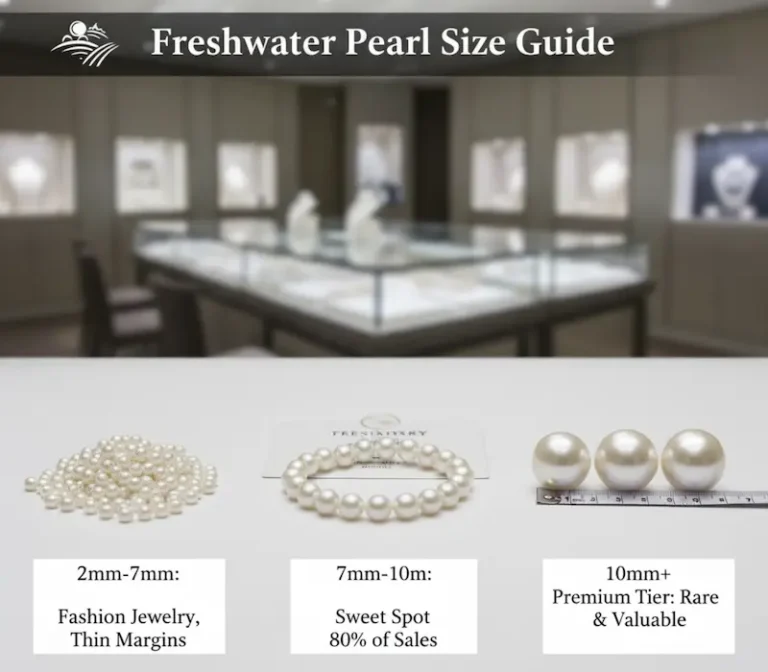
If you want to weigh pearl sizes before locking in a grade, our pearl size guide shows how the various millimeter ranges actually read once set in jewelry.
| Pearl Type | Shape | Size Range | Grade Sweet Spot | Application |
|---|---|---|---|---|
| Freshwater AK | Round, off-round | 2–6mm | AAA–AAAA | Delicate jewelry, minimalist strands |
| Freshwater AK | Button, oval | 3–6mm | AA–AAA | Small earring studs, bracelet |
| Standard freshwater | Rice/potato | 3–7mm | AA–AAA | Layering necklaces, mass market |
| Standard freshwater | Button | 6–10mm | AAA–AAAA | Earrings, pendants |
| Standard freshwater | Oval | 7–12mm | AAA–AAAA | Drop earrings, asymmetric designs |
| Standard freshwater | Baroque | 8–15mm | AAAA–AAAAA | Statement jewelry, artistic pieces |
| Standard freshwater | Round | 6–9mm | AAA–AAAAA | Classic strands, fine jewelry |
| Edison | Round / near-round | 9–14mm | AAAA–AAAAA | Luxury pieces, South Sea alternatives |
| Edison | Baroque / oval | 10–16mm | AAAA–AAAAA | Designer focal pieces |
Two size points deserve to be spelled out. First, across the 2–6mm AK range the per-pearl price is modest but the labor per strand is steep — far more pearls to sort, grade, and string — so fold that into your margins. Second, Edison pearls over 13mm are truly scarce and priced to match; don't plan for 14mm Edison at AAAA volume the way you would for 10mm rounds.
Behind the scenes: how we sort millions of pearls
Freshwater pearl farming turns out staggering quantities, and hardly any of it clears the premium bar. One harvest may produce 100,000 pearls spanning every shape and size, yet only around 2,000–3,000 of them ever reach AAAA or AAAAA. That single ratio dictates how a grading operation has to be built.
We grade in two passes. The first is automated: optical machinery sorts by shape class, flags obvious surface faults, gauges diameter variance, and reads size. It runs nonstop and clears the bulk volume efficiently.
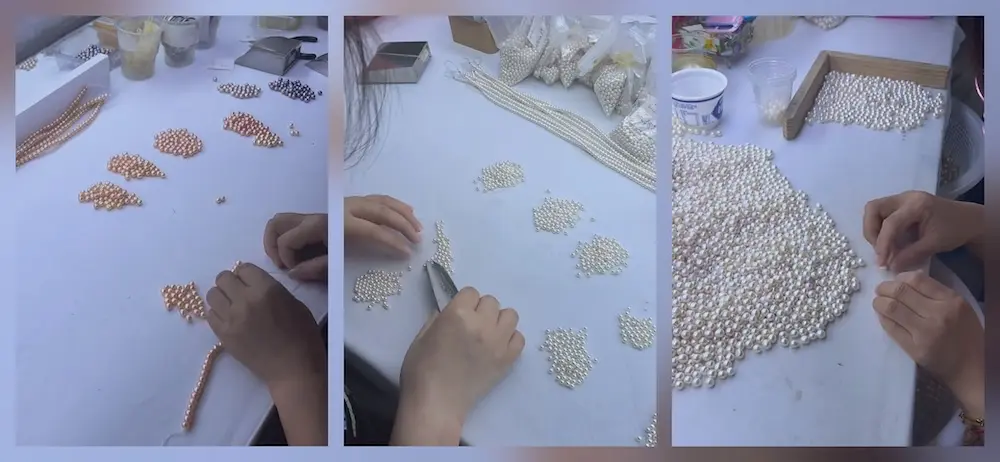
The second pass is done by hand. Every AAAA and AAAAA candidate, whatever its shape, moves to seasoned graders working beneath calibrated daylight-equivalent lamps (6500K, D65 standard). They keep reference samples at the bench for each session — a AAAA button reference beside a AAAA baroque reference — so every comparison stays true to shape. That discipline is how a pearl manufacturer keeps its grading consistent across shape classes and across repeat orders.
Grounded in Freshwater Pearl Grading, you are ready to sharpen the choices you make while sourcing.
On baroque pearls the human pass counts for even more than it does on rounds. Machinery can measure surface area and catch visible faults, but deciding whether a baroque's luster is genuinely strong across its uneven contours takes a grader who has handled enough of them to trust their eye. We never cut that step from baroque and oval grading.
FAQs
What is the difference between Edison pearl grading and traditional freshwater pearl grading?
The dividing lines are roundness criteria and how nacre thickness is handled. Traditional tissue-nucleated freshwater pearls are pure nacre — no bead sits inside, so the entire pearl is nacre. Thickness simply isn't part of their grading, because there is nothing to measure it against; it's all nacre. Roundness gets scored as a percentage of deviation from a perfect sphere, and with no round core to guide growth inside the mussel, true rounds stay rare — under 3% of most harvests. Edison pearls, by contrast, are bead-nucleated. A round shell bead is seated first, giving the nacre a spherical template to build on, so high roundness becomes far more attainable — but now nacre thickness turns into its own grading factor. We measure it on Edison pearls and require at least 0.8mm for AAAA and 1.2mm+ for AAAAA. Thin nacre over a large bead can look fine on day one, then wear badly across years of use, and seasoned retail buyers increasingly ask about it. AK pearls — the smaller nucleated freshwater type — fall under the same nacre-thickness rules. An AK pearl carrying 2mm+ of nacre has a structural soundness that a same-size rice pearl (all nacre, but grown irregularly) often can't match for durability or lasting luster.
Can a pearl be perfectly flawless?
No — and any grading scheme that says otherwise is making a marketing claim, not a technical one. Pearls take shape inside a living creature over 3–7 years, and some trace of that growth almost always lands somewhere on the surface. Our AAAAA label means under 1% of the surface shows any anomaly at 10x magnification and nothing visible at normal viewing distance. In practice, that is what "flawless" means. For baroque and oval pearls the yardstick changes — we judge how evenly luster carries across an irregular surface rather than how clean a sphere is. A AAAAA baroque shows mirror-grade luster over nearly all of its surface, with growth lines — which are natural structural features, not blemishes — left uncounted.
Does drilling affect the pearl grade?
A tidy drill hole through a first-rate surface leaves the grade untouched. What matters is what drilling exposes or conceals. A hole exiting through a blemish on a pearl's back can tuck a surface flaw inside a strand knot — and it happens. When you buy freshwater pearls pre-drilled, ask whether drilling came before or after grading, and ask to inspect the exit holes on sample strands. On AK pearls and small baroque, the hole is proportionally large against the pearl, so study that closely on samples before you commit to volume. Button pearls are normally drilled through the flat base to the flat face. A center-drilled button with a clean, square hole seats face-up correctly and hides the hole in the mounting. A poorly drilled one tilts in the setting and spoils the whole piece no matter what grade the pearl is.
What is the best freshwater pearl grade for wholesale jewelry?
For most wholesale collections, AAA and AAAA are the sensible picks. AAA carries everyday retail pieces comfortably, while AAAA suits premium strands, earrings, and lines where sharper luster and cleaner surfaces earn their keep. AAAAA pearls are considerably scarcer and tend to be held back for high-end designs or special orders.
Ready to source high-quality pearls?
Stop paying for vague grade stickers. Whether you need 2mm AK pearls for a delicate chain line or 14mm Edison baroque for a flagship collection, our stock is graded to the exact standards laid out above, and we can supply documented surface and luster ratings for any tier on request.
If factory-level sourcing is new to you, begin with a sample order covering two shape classes and two grade levels. Holding AAAA and AAA button pearls side by side — before you scale up — is how you train your own eye for this material.
Explore our full stock of wholesale pearls sorted by grade and shape, or reach out directly for current pricing on bulk pearl orders. Factory-gate prices, no middleman markup, and sample strands within 5 business days for most grades.
View our Edison Pearl Collection → or Request a Wholesale Quote.
Weighing grades for a wholesale order? Send us your target size, shape, color, and quantity, and we'll recommend suitable grades and put together sample options ahead of bulk production.